Sunday, March 13, 2011

What Sound Does a Bird Make?

Wading gradually into Finnegans Wake, supplied by several commentaries with some concepts. and in the absence of money to buy the book of annotations (because virtually every word in the Wake is a pun, often several, and frequently in two or more languages--like I said last time, this book is complicated), an online annotation which helps unravel the puns and the many languages and layers.

Joyce being Joyce, there is humor in every word and every pun. Joyce views the human tragedy of life and the many kinds of violence humans execute on one another through the lens of all humans being psychologically the same. Therefore we humans do violence only on ourselves, and this violent, tragic life becomes a rough comedy, a hurly-burly. The violence humans perform on themselves is a necessary part of pent-up energy being released and helping to create more life. Humans are humans like, for Red Sox fans of the aughts, Manny was Manny. Self-destructive behavior is not universally destructive but is, rather, the means toward more life (or, in Manny's case, more clutch baseball).

So the book is filled with references to sex, whether between husband and wife, or adulterous, or cross-generational, or incestuous, and every reference is humorous and tinged with a sense of nature, of inevitability (like how hurricanes are statistically inevitable in the Gulf of Mexico). The sexual humor is wry and incessant. From the online commentary I'm relying on comes a note concerning a Japanese element ("kaminari", thunder) in the text: 'Joyce asked me "Aren't there 4 terrible things in Japan, 'Kaminari' being one of them?" I counted for him: Jishin (earthquake), kaminari (thunder), kaji (fire), oyaji (paternity)." And he laughed - Takaoki Katta, 15 juillet, 1926.'

That snippet is a' propos of nothing except that I found it funny. Even from the land of zen and dour samurai we have paternity jokes. I suppose we humans are alike after all.

I'm posting more now because my spirits have risen considerably over the past week or so. In no small part this is because I'm finally on a regular income (though small) of unemployment payments. I'm not proud of that except that it enables us to pay our bills, which had been piling up unpaid for nearly two months. Add to this that spring is definitely approaching--not even another blizzard or two will undo the thaw we've had--and today was (Surprise!) daylight savings day. I woke to our automatic clock, which reads the time through the power grid, telling me that it was nearly nine.

So much for an early start to the day, eh?

But now it's nearly seven and twilight still hangs in the air. And that's good. Trees are now filled with twittering birds so that Eva constantly points them out when she can hear them from inside the house. Morning and evening she points toward the window and says, "Bud-dy."

The return of birds and the noise they make makes me think of when I first moved away from New Hampshire, down to Boston to live and work with my cousin Drew. We lived on P Street in South Boston, still the Irish end of town then (nearly 20 years ago), and one block from Columbia Park which looks onto the bay and the old revolutionary fort which guards Boston Harbor. The tip of Southie, which sticks like a thumb out into the harbor, is a mile or two across the water from Logan Airport, and when the wind is out of the southwest, we were under its takeoff pattern. This made for noisy evenings.

(A side note: commercial airports double as gigantic weathervanes. When I saw eight planes stacked up on their landing approach to the south, I knew that the wind was out of the north-northwest, and we were in for good weather for a while. Anyhow...)

So Southie was loud, between the family upstairs (and the father, falsely claiming medical disability like half the other people I met in that neighborhood), the caterwauling tomcats all night outside, the passersby in the street, and the planes overhead. And no birds.

Oh, there were some seagulls, and perhaps a crow or two, but certainly no songbirds. Nothing you'd want to open up a window, sit down with a cup of coffee, and listen to. Just city toughs getting along, like all the other animals (including humans and insects) there.

I moved down in February, in the midst of a very snowy winter (and I learned just how territorial and irrational these folks could be when it came to claiming and defending parking spots). I didn't visit my parents in Moultonboro, on the northern tip of Lake Winnipesaukee, in New Hampshire until mid-June. I drove up one Friday evening, opened my bedroom window open because it was really hot, hopped in bed and went to sleep.


The following morning, around 5:30 AM, I was awoken by a screaming clatter like I'd never heard in Boston. "EEAAHWRAAKKEEII-NAKAAWEEEIIKKIEEAAWRAAAAEEIIKIIEE!" and on and on and on.


The birds.


It was as if 10,000 birds were sitting outside my window, and suddenly on cue, began screaming at maximum volume in one deafening chorus.

(Calvin and Hobbes has long been my favorite cartoon strip, occasionally displaced by Doonesbury and The Far Side. But Snoopy is unassailably my favorite character. Can't touch Joe Cool. He's as elemental as anyone in the Wake.)


Back to the startlingly loud birds. I jumped out of bed, pretty scared, until I realized about five seconds later what the noise was. Of course I had a good chuckle at myself but there was no way I could go back to sleep so I just went downstairs and joined Mom for a cup of coffee.

Fast-forward to today. That story about the screaming is one of the ones I've told Kate three or four dozen times. On account of the sudden influx of songbirds, and the (still leafless) treetops filled with chattering flocks in the twilight, tonight was one more. And I added the sound effect, "WRAAAAEEEAAAGHH!"

Kate, generally more attuned to these things than I am, commented, "You're startling Eva."

So I turned to Eva. "Birds," I said, "go WRAAA." and bugged my eyes out. Eva reacted with her startled, fearful laugh, and her answer said it all: "Bankie." (Whenever she's dismayed or scared her first thought is for her blankie.)

Kate, not pleased, objected. "Birds go tweet-tweet-tweet." And she made the ASL sign for a bird, thumb and forefinger opening and shutting in front of the lips.

I made the same sign and insisted, "Birds go WRAAA."

Eva wasn't sure who to pay attention to, but she was showing signs of maybe wanting to start crying, so I backed off.

But later on, as Kate read her a story before bed, the story mentioned a crow.

"Wraa," the baby said, and looked at me.

Hyah!

Thursday, March 10, 2011

Gusto

Kate and I try to avoid having too many "What bills can we pay this week?", and "Well, that payment bounced, we'll try it again next month" conversations. Yes, we keep only loose track of our money, but it's not like I go out gambling and drinking, and we don't like antagonizing ourselves or each other with the obvious. We're not poor, but we're not rich.

If you look at life economically, in terms of a person's earning potential, then I'm still not really worried. My line of work is transferable internationally, with the right licenses and a bit of language brushup. So if the economy ever unfreezes enough for a galoot with a few years' experience to slip his way through a door again, then I have reason to feel good about the years to come.

Of course, like an ancient Irish poem says about spring: it's pretty, but there's no food. Hope isn't dinner.

About fifteen years ago, while I was drunkenly schlepping my way through my 20's, a beggar in Boston asked me for money. I walked past, and thought, I have quite a bit of credit card debt right now that I can't pay off. Total all my assets and liabilities up--books versus debts--and I'm in the negative. I'm worth less than that beggar! It left me thinking that I should go back and demand money from him.

That's nonsense, of course, because I have an education and had the prospects of receiving money from a reasonably well-off family. In other words, I had support and the potential to earn that the beggar most likely didn't. (Although some beggars might have suprising personal histories. One slovenly drunk I knew was a black-sheep castoff of a Boston Brahmin clan.)

Anyhow, my main point here is that there is no mystery in the presence or absence of money in a person's life. Unless one wants to live off the grid (the little bengal's floated it once or twice), money is an essential tool. So Kate and I try to avoid wrangling too often over it, when our general situation is pretty obvious to both of us.

In the meantime, while Kate works, I've mentioned studying math and geodetics (the science of locating things geometrically on planet Earth), but I'm also taking the opportunity, like last year in the hospital and afterward, to dig into some literature I've been neglecting for some time. Like last year, it started with Thoreau.

(Well, last year it started with Shakespeare and Chaucer, but once I got to Thoreau, I realized I'd found a writer I could understand instinctively. So in that sense it started with Thoreau.)

Thoreau, during his discourses, mentions many old writers. Walden is a modern Confessions, a sincere psychological self-profile by a mature adult male. In the Confessions Augustine describes his conversion to Christianity, and in Walden Thoreau describes his two-year experiment to simplify his life so as to eliminate all unnecessary things, or in his own words, "all that was not life." Both discuss the writers which influenced them--Augustine famously writing that he fell in love with Vergil's heroine Dido, and Thoreau spreading his affections a bit more widely.

Time in Walden is somewhat kaleidoscopic, with many different moments of time merged within one picture. The book moves generally through the four seasons, but with two years' experience compressed into the apparent passage of one single year, and even then, sometimes Thoreau will range across several months, or even years, to find another memory which illustrates a point. And during the course of this not-quite-passage of time, he describes several books, or even classes of literature, which have especially formed his thinking.

Oddly enough Thoreau never mentions Kant, whose philosophy was the basis of the label given later to Thoreau and his friends: the Transcendentalists. Perhaps Kant was as intimidating and as feared a writer then as he is among undergraduates now, and Thoreau didn't want to scare off his readers. In any event, Thoreau never mentions him.

He does, however, discuss Homer at length, and Hindu philosophy in general, at even greater length. In "A Week on the Concord and Merrimac Rivers" time passes even more vaguely--where a few weeks seem to encompass the passage of spring to fall, as well as several extended forays into memories from years past--and the discourses on literature are longer, and nearly as fascinating. (I'm ashamed to admit that in one of his essays, Thoreau lavishes praise on the Scottish poet Ossian, supposed author of several Gaelic epics. Unfortunately, by Thoreau's time Ossian had long been revealed to be the fraudulent creation of the Scottish poet James McPherson, who had taken actual ancient Gaelic fragments and incorporated them into several English works of his own invention. The incomparable Samuel Johnson, who almost immediately detected the counterfeit, wrote that the books of the nonexistent Ossian were as "gross an imposition as ever the world was troubled with." And nearly a century later, my intellectual hero fell for it. Ah well.)

In Walden, Thoreau celebrates the heroism less of the characters than of the poet, whose work is a joyful affirmation of piratic and warlike life in bronze age Greece. And all Homer's heroism is overwhelmed by a tiny moment's experience in his own life: "I was as much affected by the faint hum of a mosquito making its invisible and unimaginable tour through my apartment in earliest dawn, when I was sitting with door and windows open, as I could be by any trumpet that ever sang fame. It was Homer's requiem; itself an Iliad and the Odyssey in the air, singing its own wrath and wanderings. There was something cosmical about it; a standing advertisement, till forbidden, of the everlasting fertility and vigor of the world."

Literature speaks very much to writers of literature. However, life speaks to everyone, and literature might at best describe outlines or echoes of what we live every day. But these outlines and echoes can be valuable clues by themselves for living. To the literary woman or man, however, not only the content but the aesthetic is the lesson. What matters to me is not only the experience and thought compressed into Thoreau's words, but the arrangement of words themselves. When he blends time together imperceptibly, turning his Walden calendar into a delicate fiction, I am charmed and intrigued. When two weeks become nearly one full year on the river, spanning from spring to the onset of winter, I'm inspired to find the more rapid seasons within my own life.

So I wanted to take Thoreau's advice: go back to the source. Every source has its source, of course, and when the person we call Homer was composing poetry, the stories he (or she? I subscribe to the idea that a woman composed the Odyssey) was telling in verse might well have been ancient beyond memory. (This is Thomas Mann's time coulisse, the endless dive into human memory. "Very deep is the well of time. Shall we not call it bottomless?" he wrote.) Unfortunately, Homer is our earliest coherent source for these Greek stories, and fortunately they are told so magnificently that they along with the Bible have formed the unmovable foundation for European and American literature.

The Iliad is all about war, and shines with soldiers' joy in their work. Death is more than a necessary evil--it is a tool for gaining fame. Mankind's spirituality was still in its childhood, with godly male and female characters displaying our species' psychology on a cosmic stage. Whether acting unseen by the mortals within the poem, or planting suggestions within the humans' brains, the gods and goddesses perform psychologically valid acts. They are part of the framework for displaying the humans in the poem.

The role of gods and goddesses--mainly Poseidon and Athena--in the Odyssey is the same as in the Iliad. The main character is Odysseus, a man; Poseidon, also male, is the principle divine antagonist, and Zeus, another male, remains the high arbiter of the gods. However, Odysseus and his son Telemachus live in a world of settled homesteads, where the heroic culture is counterproductive at best (think Ivanhoe). The Odyssey occurs largely in a world dominated by women, where Penelope is the focus of over a hundred brawling and blasphemous suitors. Athena, the crafty goddess of wisdom and battle, quietly guides both Odysseus and his son through a series of desperate adventures, none greater than ridding the palace of the mob of suitors.

Helen, adulterous cause of the Trojan War, is beyond reproach and beyond analysis in this story. She so thoroughly dominates her (apparently rather stupid) husband King Menelaus of Sparta, that he can adoringly tell the story of how, when he, Odysseus and others were crouched within the Trojan Horse, Helen walked round it, with her (second! After Paris had been killed) Trojan husband, calling the names of the principal Greeks--imitating their wives' voices. Menelaus' tale comes just a few lines after Helen had condemned herself as a prostitute, and said that her mind had changed at Troy, and she wanted only to return to Menelaus and the Greeks.

The point that defies analysis: if Helen told the truth about wanting to forsake Troy, why try to flush the Greeks out of the horse? (And the sequence of time is clear: Helen mentioned wanting to leave Troy behind before the horse was ever brought in.) But if her self-accusation was a lie, why bother to tell it when it's so unbelievable? In no small part because Menelaus was gullible enough to believe her. And this is just the beginning of the mystery that is Helen, and the theme she so grandly introduces, of duplicity. Whether calculated, or subconscious, or simply to cover up a monstrous crime, the poem is a nearly unbroken series of deceptions.

Helen's physical beauty is undeniable. Her magic, on display more than once, is almost terrifying. Her motives in using it, inscrutable. She is both greater and less than Penelope--faithless follower of her own advantage, and capable of steering the minds of anyone she is with. Penelope, unspeakably faithful, is clever but not magical and is held almost prisoner by her illegitimate suitors.

Odysseus, the lone adult male profiled at any length in the poem, exists almost in isolation. Even his son Telemachus, introduced earlier, is constantly described as just exiting adolescence and entering adulthood--so he is hardly comparable to his father. It is the several female characters--Penelope, Helen, Circe, Calypso, Nausicaa, even Athena--who can be compared to each other, and who at various times (except for Helen) hold Odysseus' fate in their hands. Rejection by any one of these would mean death (or, in Penelope's case, worse) to the poem's namesake.

This is not to become a dissertation on my favorite book. I just wanted to explore a few themes which I've been considering since re-reading it. Like the Iliad, and I'll agree with Thoreau here, joy suffuses the poem, in the acuity of description, the detail which validates the story as a whole, and in the overall affirmation of the lives of its characters.

So I want to keep taking Thoreau's advice in Walden, "Read the best books first, or you may never have the chance to read them at all." So I'm moving from translated Homer, as my warmup, to possibly the most intimidating book in Western literature: Finnegans Wake.

Joyce took the title from a 19th-century Irish folk song about the wake of Tim Finnegan, a mason (well, a hod carrier: the guy who brought bricks and mortar up to the bricklayers) who fell off a ladder and died. At his wake there was a fight, and someone accidentally splashed whiskey on his face as he lay in the open casket. Finnegan awoke and joined in the party.

There's a bit of etymology behind the name "Finnegan": the name comes from "Finn-again", as in, a reincarnated version of the hero from Irish myth, Finn MacCool. That's precisely the kind of trick that Joyce adores, so who am I to deny it? (Joyce is the one who wrote, "God is dog spelled backwards.") So with the death and reincarnation of Finnegan, Joyce is dealing with the process of sin, guilt and redemption. And that's just the itsy-bitsiest kernel of things.

I can't really even describe what that book's about, except to say that it's about everybody, and everything. Since all humans share the same basic psychology, we all play out similar psychological dramas in our lives. Based on this, Joyce's book is full of male and female characters which are all ultimately lesser parts of, and distorted expressions of, the two main characters: HCE (Humphrey Chimpden Earwicker, or Here Comes Everybody), and his wife ALP (Anna Livia Plurabelle).

Their two sons Shem and Shaun are utterly opposite in nature, and constantly fight. They are the source of all wars in history (with a generous assist from their sister the temptress). The daughter Isabel is the object of all the males' attentions (not least her brothers and father). Within these five characters is the grounds for Joyce to display and explore all human history. Finnegans Wake is the fantastically complicated journey of exploration. (And that point I made earlier, about meaning plus aesthetic...well, let's just say, I really don't want to get too far into that topic right now.)

"riverrun, past Eve and Adam's, from swerve of shore to bend of bay, brings us by a commodious vicus of recirculation back to Howth Castle and environs."

That's how the book begins.

"Coming, far! End here. Us then. Finn, again! Take. Bussoftlhee, mememormee! Till thousends thee. Lps. The keys to. Given! A way a lone a last a loved a long the"

That's how the book ends. Note how you can go right back to the beginning from the end. And that's one of the main points of the book: the story never ends, and it's the same thing over and over. (And it's worth mentioning that the title, "Finnegans Wake", has no apostrophe indicating the possessive. It's really a statement that all we Finnegans must wake up from our guilt-imposed psychological self-abuse: our own death, in a manner of speaking. And in another sense, Finnegan wakes in the form of children who grow up and take their parents' place in the world.)

The book is too complex, and I have too much to learn about it, to waste anyone's time blathering about it now. But I intend to learn. And I'm getting ready to write my own, but you might say I'm taking a good stiff draft of excellent literature to prepare my own spirit for the act of writing.

* * *

A version of the Irish ballad "Finnegan's Wake" I picked up from the internet:

Tim Finnegan lived in Walkin' Street,
A gentleman Irish mighty odd;
He had a brogue both rich and sweet,
And to rise in the world he carried a hod.
Now Tim had a sort of a tipplin' way,
With a love of the whiskey he was born,
And to help him on with his work each day,
He'd a drop of the craythur every morn.

Chorus:
Whack fol the dah O, dance to your partner,
Welt the floor, your trotters shake;
Wasn't it the truth I told you,
Lots of fun at Finnegan's wake!

One mornin' Tim was feelin' full,
His head was heavy which made him shake;
He fell from the ladder and broke his skull,
And they carried him home his corpse to wake.
They rolled him up in a nice clean sheet,
And laid him out upon the bed,
A gallon of whiskey at his feet,
And a barrel of porter at his head.

Chorus

His friends assembled at the wake,
And Mrs. Finnegan called for lunch,
First they brought in tay and cake,
Then pipes, tobacco and whiskey punch.
Biddy O'Brien began to bawl,
"Such a nice clean corpse, did you ever see?
"O Tim, mavourneen, why did you die?"
"Arragh, hold your gob," said Paddy McGhee!

Chorus

Then Maggie O'Connor took up the job,
"O Biddy," says she, "You're wrong, I'm sure",
Biddy she gave her a belt in the gob,
And left her sprawlin' on the floor.
And then the war did soon engage,
'Twas woman to woman and man to man,
Shillelagh law was all the rage,
And a row and a ruction soon began.

Chorus

Then Mickey Maloney ducked his head,
When a noggin of whiskey flew at him,
It missed, and falling on the bed,
The liquor scattered over Tim!
The corpse revives! See how he raises!
Timothy rising from the bed,Says,
"Whirl your whiskey around like blazes,
Thanum an Dhoul! Do you think I'm dead?"

Chorus

Wednesday, March 9, 2011

Strawberry Milk and Bounced Checks

Since Kate seems to have lost the ability to type, and posting a sign video would use too much bandwidth, and only a few folks could understand it anyway, it looks like I'm going to be doing all the posting for the foreseeable future. And my glacial posting rate assures that we've lost the few readers we ever had, so I suppose I'm writing now pretty much for myself, Kate, and maybe Eva if she ever chooses to read this.

Oh, well.

I've honestly felt like there's little to post this winter, as the family struggles through a period of scarce money and half employment. Kate's borne up valiantly with her job, when she's told me many times that she'd rather be home with Eva. And I'd love to give her that freedom--I hope to still, in years to come. Despite the steady erosion of America's middle class, I hope to earn enough that Kate can be a full-time mother. I grew up with one of those, and despite the times she kind of aggravated me by asking tons of questions when I didn't feel like talking (which was actually kind of rare, that I wouldn't feel like talking), it was pretty good having a mother around all the time.

On the other hand, I did grow up pretty sheltered and dependent, so there are consequences to everything. But hey, as a race we have to roll with the psychology we're born with, so I won't be listing complaints.

And that gets to the seed of why I haven't posted much lately. This is a theme I've mentioned a few times already, but I feel the need to discuss it again now, if only due to the persistence of my shame and frustration with the trouble we've been having lately. I've backed myself into an industry segment--offshore geology and geophysics--which is strongly seasonal. On top of that, I've had some significant debts--mostly the condominium, but also some credit cards--to dig out from beneath. Kate of course had nothing to do with creating these problems, but she's had to suffer through the period of solving them. And no small part of that has been my anger and self-isolation resulting from ongoing lack of money, and knowing that my choices have led directly to this.

There aren't many nights when I don't dig through old memories, mostly from college, and accuse myself of the laziness and indifference which led to me as a 40-year-old struggling to establish a career in marine science. When I went to Dartmouth I had no intention of becoming a professor, and I gravitated toward Greek and Latin only because I had an excellent Latin teacher in high school (thank you again, Mrs. Moser!). But at Dartmouth I never took the prospect of academic achievement seriously, for many tangled reasons, and not until my late 20's did that attitude change. Since then I've struggled to narrow down and specify what I want to do, and how.

Meanwhile investment bankers ruined the world economy and I'm left holding a very empty bag of vague aspirations, and hoping that I haven't doomed myself and my family. I don't always feel so bleakly, but it's an impossible thought to escape completely. Buddha I'm not.

My days don't really have a routine, except what centers around Eva: breakfast between 8 and 9 (depending on when she wakes up), shower while she watches a Signing Time video, lunch around noon, 30-40 minutes of her running around outside, followed by her afternoon nap, when I'm free to do what I like around the house. Generally this is my time to work on math, since I have a bunch of loose sheets of paper and a couple of pencils lying around, normally things (especially the pencils) I don't want her getting her hands on.

I'm proceeding right now in the hope that I will get into UNH, working on a few types of math which I'll need as an ocean mapper. And even if I don't get in, I'll be disappointed but I'll carry on learning this and apply it in my private career. I'm not about to give up, despite my rage and embarassment throughout this winter. Kate has suffered through this extended mental darkness of mine, and we've had some bright moments but she's usually found slight comfort in me.

Eva remains a smiling, dancing, and increasingly talkative baby. In my dour moods, while I'm reading at the computer, she'll trundle up with her blankie (the red one is becoming her favorite, and I'm not surprised) and ask to sit on my lap. Once there she'll lean on my ribcage and suck away on her blanket. I don't like her to retreat into her blanket for very long stretches outside of her naps, so I'll generally do something with her after a few minutes. But she breaks through even my desk meditations.

I still drop the occasional inappropriate word in her presence, and she's given to repeating the last word she heard, so I've been momentarily humiliated on a number of occasions by my own foul mouth.

Eva loves to go outside, and she's learning to love splashing through mud and puddles of water. Last fall she learned to love grabbing dirt from the half-barrel in the driveway and flinging it over her shoulder. The dirt in the barrel is still mostly frozen (not for long, though!), so she can't do that yet. But she does love to pick things up and hand them to me--leaves, tufts of grass, pebbles--though fortunately no deer scat (and there are piles of it all over the yard).

I've resumed singing drills in the morning, after my shower, and Eva has resumed her somewhat uncertain relationship with my singing, alternately intrigued, or milling around somewhat indifferently, or standing in the doorway with her blankie and managing the occasional sob as she looks at me. She's probably angling for attention, but I do sit down with her on my lap afterwards and show her the keyboard. (That baby will know the notes A-G, as well as what an octave, a third and a fifth are before she's three. Maybe before she's two...then we'll work on chords.)

So Eva's delightful, hardly my only joy, but certainly one of the major joys in my life. My little bengal, though she's often feeling as much or more stress than I am, is another. And carrying on with intellectual work even while unemployed is another.

But some things Eva isn't quite so wonderful at--drinking milk is one. It's nearly impossible to get her to drink any. It's gotten to the point that she expects it at dinner, and if we use a sippy cup she doesn't normally use (like one you can't see through), she'll inspect it carefully and try to see any drops of milk on it. Then she'll try the drink, and if it's milk, her face will wrinkle slightly and she won't touch it again.

We tried chocolate, but Kate's mom says that the chocolate binds up the calcium in the milk, effectively canceling out its main benefit. But I haven't seen anything like that written about strawberry flavor, so I've given it a try on little Rocky these past few nights, with marginal success at best. Kate and I give Eva two spoonfuls of calcium supplement every night, but Eva's still too young to understand language to the point of bargaining--such as, "Drink your milk or you won't leave the table." I see plenty of standoffs like that in years to come. And though Eva's revealed herself to have a temper like mine, those aren't standoffs I intend to lose. As Bill Cosby once said, "You don't mess with Dad. That's the old gunfighter, jack."

As for the other part of this title--bounced checks--well, yeah, we bounce a few every month. Neither of us has mastered, or even tried to learn, the lost art of balancing a checkbook. And I suppose our week-to-week budgeting skills are pretty meager too. But some embarrassments and bank fees aside, we've survived so far, and I think we'll continue to do just that.

Sunday, January 23, 2011

Parenting

Learning how to raise kids, or in our case so far, a single kid, is constantly amazing, a series of heartwarming moments and challenges that can be funny, exasperating or humiliating, and often a mixture of these.

In living with the colitis, and pursuing the specific carb diet, I've stopped drinking coffee the way I had since college: with tons of cream and sugar. My aunt Beth, whose son Drew (my cousin, obviously) drinks it the same way I used to, derisively calls it ice cream. I learned to drink it that way from my mother, whose diet was to stay on a constant sugar high and not eat much food. Drew, I have no idea where he learned it from.

But the specific carb diet targets complex carbohydrates, the ones which the stomach alone can't digest. The theory behind the diet says that the carbs which aren't absorbed directly by the stomach--namely, anything except fructose (fruits) or galactose (organic yogurt) or glucose (simple C6H12O6, the most basic sugar)--all other sugars and starches move into the small and large intestine, and feed the invading bugs. The invading bugs don't inhabit the gut in a symbiotic way, and produce all kinds of chemicals that damage the gut and lead to the inflammation and ulcers. So the point of the diet is to starve the invaders, so they die off completely and the gut can heal. Simple theory.

These carbohydrates--sugars and starches--range from table sugar (sucrose) to the starches found in grains, potatoes and rice, and to the gluten in wheat, which allows for the light and fluffy texture of baked goods. And, last but certainly not least: they include lactose, the sugar found in milk and nearly all dairy products except a few cheeses (fortunately cheddar is among these). So grains, like for pasta and pizza dough, are out. Sugar, and I eat like my mom did, is out. And both milk and cream are out.

Basically, I'm drinking my coffee black. And when it's not espresso--or even when it is--it's frequently a pucker-up-and-just-get-through-it experience.

Since the temporary job I was working--overnight phone sales, not exactly a career ambition--came to a close, I've lost my bad excuse to ignore even parts of the diet. I was allowing myself grains--i.e. pasta, pizza and bread--again, but not milk or straight sugar. But even that was nice, because, of course, I looooooove my pizza. As does Kate, and even little Eva too. At dinnertime, now, she'll walk around repeating "piz-za," over and over and over. She's not yet 2 and her favorite food is obvious. The little girl has a lifelong love affair to look forward to.

I also enjoyed toast with my eggs--an egg sandwich with potato bread toast is one of life's genuine pleasures to me.

This morning, Kate was making breakfast, eggs scrambled with onions and two cheeses (cheddar & parmesan). It's kind of a gourmet thing, really. I took care of the toast and the coffee.

But when it came time to actually prepare the cupfuls, I realized we were almost out of sugar. At the very least I had enough for Kate's cup. (She now drinks it much like I did before, though with not quite as much sugar.) Then I looked for cream...and realized that we'd thrown it out last week, because it was bad, because I hadn't bought any since November. So we had no milk or cream.

I reported this to Kate, who had a classic Saxon retort:

"$%*&."

Eva was right there, and being the adoring, imitative child she is, answered right back:

"$%*&."

We burst into sheepish laughter and both resolved to clean up our mouths. And that's that.

Wednesday, January 19, 2011

Cranberry Juice by Wineglass

Many months since the last post. This winter has surpassed the last two for anxiety, with work on the Gulf coming to a close and nothing closer to home to replace it, except for a nighttime phone-sales gig. That work is less than fascinating, focusing as it does on a few simple things:

(1) Know the product sales script and basic info;
(2) Identify the caller’s individual reason for wanting the product, and pitch the product toward that reason before revealing the price (this process is known as “building value”);
(3) Ask, as often as necessary, for the customer’s credit card number (i.e. close);
(4) Rebut 3 times any series of excuses the caller gives for not wanting to buy (no credit card; needs to check with the spouse; needs more time to think; not sure the product is right for them).

Friendly pressure, or sometimes just plain pressure, is the method. Depending on the product and the clientele, the pitch can become contentious. Very often TV infomercials deliberately avoid pricing information, or worse, toss out a deceptive first payment which in fact represents only a small fraction (maybe 10%) of the cost. The word “free” is used frequently with borderline fraudulence, when it applies only to a limited portion of the advertised product, but the customer is left to infer that it means much more. It’s hard to fault many people being tricked—the trick is intentional, to induce them to call.

Some buyers are cheerful and rightly assume that nothing is cheap; some are skeptical, if not of the worth of the product, then at least of the incomplete pricing information; others start out angry, and grow steadily angrier during the call. A significant fraction of callers—particularly for some of the self-help programs—seem confused that a credit card should be necessary, and why we aren’t able to deliver C.O.D., or else they just mail in a check when they decide they like it. But those are still only the normal folks.

Then there are the weirdos.

Toward the end of one 9 PM to 5 AM shift—probably around 4:30—I took a call for a space heater, from a man with a strong drawl and a lot of energy.

-Hello, thank you for calling, my name is Michael. May I have your name, please?

-Hello, Michael, my name is Willie, and I’ve been drinking!

-How may I help you with regard to our heater?

-Oh, I just saw your commercial, so I gave you a call, and I’ve been drinking!

-Do you have any interest in buying one this evening?

-No, I don’t care at all about those, but I’ve…(click)

On the call cancellation form I checked that one off as “Crank caller”.

Frequently, and especially for self-help programs, people call up with very intense personal stories, in desperation to talk to someone. Depending on my patience level and overall state of mind, I might consider them poignant, humorous or simply moronic. One man called me up and talked about his time in prison, and how it was harder being back out. He was so drunk he couldn’t remember his zip code. And that was one of the better conversations I had all night.

So satisfaction is hard to come by on this job, especially when the job is an hour away, pays $10 an hour and I work overnights. It’s come to this while I await news from the doctorate program I’m seeking to transfer to, and as I hope for anything else—temporary or full-time—to come back from the rafts of applications I’ve sent out. Few times in my life have I felt so impotent and angry—maybe never. I lived my 20’s with no clear purpose, and only during my 30’s have I been chipping away at the shape of a career in earth science, steadily eliminating options and gathering knowledge and forming goals.

So now I find myself 40 years old, in a career situation many people much younger than I are in: having limited prospects during an historically bad downturn due to a brief track record in their present line of work. I’m frequently furious with myself over this, but I also have my life to go on living, and a wife and daughter to support (though Kate’s making most of the money right now. But I do shovel the driveway and wash the dishes).

Fear, bitterness and anger have been regularly occurring emotions of mine for months now, especially at holidays when family gathers. I look at this as paying my emotional dues, heading for an ambitious career again after taking nearly a decade of my life off, and coping with the challenges and my built-up feelings of inadequacy. If I’m to prove equal to my hopes, then I have to let the fear, bitterness and anger go—feel them, know their causes, and let their energy bleed away to zero. As I do this, and as I gain the skills and experience to work at a very high level, I feel the weight of failed potential falling from my shoulders, relieved by the lightness of accomplishment. That process is incomplete, at times moving along very slowly—right now, virtually not at all.

Many nights I’ve lain awake watching the digital clock count the minutes toward dawn—though that’s not my problem now that I stay awake until dawn anyway. If only the YMCA were open 24 hours a day, I’d be golden—in the best shape of my life. As it is, I rip off a few laps in the pool (up to 7, after several years off—hey hey) before returning the car to Kate for her to skedaddle up to work in the morning. She leaves with Eva, and I go to sleep.

That’s our life right now. Although I do like swimming in the morning, I’m not fond of the night shift.

I’ve been dealing with colitis since May—obviously, before then as well, but unknowingly, and without medication—and it continues to be an annoyance. Chronic diseases in general are unpleasant socially, particularly digestive disorders, and above all those which, like colitis, have largely unknown causes.

Anyone who’s experienced cancer in the family, and has done any reading on alternative therapies, knows that there are many theories behind the disease which focus on a compromised immune system. Hospital physicians will not necessarily concur. A similar situation exists within the field of Crohn’s disease/colitis/celiac disease, three digestive disorders which result in diarrhea and sometimes bowel punctures. Surgeons and diagnosticians will tell you the causes for each are unclear.

Off-the-shelf books will tell you that they are due to microbial infestations of the gut, frequently resulting from repeated courses of antibiotics which wipe out white blood cells and the ordinary populations of benign gut bugs and allow room for the invaders to take over. These new, unfriendly bugs interfere with the gut’s operation, causing damage and impeding digestion. Several drugs, of varying strength and severity, are available to manage the symptoms. I’m currently on the second tier out of three, in terms of severity. Beyond tier three is surgical removal of the colon.

However, the books will tell you that a road to cure—outright cure—lies through starving out the invading bugs, by eating no carbohydrates and only extremely limited forms of sugar (fructose and galactose—absolutely not table sugar, sucrose, or lactose, which is found in milk and dairy products). Two years or so of never eating these things should be enough to starve the bad bugs out and let the gut recover.

Sounds great, and I began it after Thanksgiving, but I’ve let myself go. I did lose 20 pounds in about 3 weeks—this “specific carb diet”, as it’s called, is basically the Atkins diet plus no dairy products—but once I began working this overnight job, my state of mind plummeted even further. I felt that in order to make it through an annoying job assignment, I’d need some comfort food—frozen pizza.

So I’m breaking the rules, selectively. Grains and some foods with sugar—like jelly, tomato soup, the occasional soda—are back in. But pure sugar and the dairy are still out. Maybe that’s like committing only a little treason, but I also don’t want to get back into all my old habits when I know that I hope soon to have a day job again and not need the comfort food as a crutch.

Even so, one of our phone products is this juice derived from the fruit of the nopal cactus—prickly pear juice, it’s often called. (I won’t be posting the brand name online.) We pitch it as an anti-inflammatory pain reducer, the juice naturally full of antioxidants which remove toxins from individual cells and ultimately reduce muscular, pulmonary and cardiovascular swelling. Sounds great—maybe not so great at $40 a quart, but still, the testimonials are impressive.

Then do a little online hunting. The nopal fruit—prickly pear—is simply one of a group of fruits with antioxidant properties, generally dark berry fruits. Nopal, açai berry, blueberry, cranberry and pomegranate are on the list. So you can buy the prickly pear juice over the phone for $40 a quart, or you can go to a store and buy some pure cranberry juice for $4 a quart, and probably feel the same bodily effects over time. The prickly pear juice might work very well, and live up to its billing, but it costs ten times as much. In that comparison you can find my contempt for phone marketing.

Still, Kate has become concerned with her own intestinal health, and has looked into antioxidants as a means of furthering her and my health, and wanted to try cranberry juice. Of course she found the most expensive, fruity fruit brand at the natural foods store (albeit still 8 to 10 times cheaper than the phone stuff), but I went for a cheaper, slightly cut-rate (but still no sugar added!) supermarket brand. She’s disgusted with the juice I bought as being too sweet. She wants the sour stuff, the straight cran.

Reminds me of a story I read about the great Confederate general, Stonewall Jackson. He’d been a heavy drinker in his youth, but later quit. While marauding with his army all over the battlefields of the Civil War, he was well-known for sucking on lemon slices. A fellow officer asked him one day why he sucked on the lemons.

“Because I hate them,” was the answer.

Sounds a bit like my little bengal.

Of course whenever I do anything I like it a bit ceremonial. I like my windows big and church-like, my living room like a sanctuary. I want the formality of a library room. I like a long dining table with candlesticks and a centerpiece. I go for tuxedoes and long, swooping waltzes. Big concerts and crowded halls full of formally-dressed people make me feel tingly. Not that I want my life to be stuffy—anything but—but I take comfort in grandiosity and a certain amount of ritual, enough for people to slow down and appreciate themselves and each other. Don’t ask why—it’s just who I am. I’m 40, and that part of me isn’t changing.

So even when it comes to cranberry juice, I like to dress it up a bit. Include the fact that we’ve dropped TV and internet service and keep our house at barely 60 degrees in order to eke our money through the winter, and putting a bit of ceremony into dinner where there was none is another big mental placebo. So the cranberry juice goes into wineglasses. Kate didn’t object. (To the wineglasses, that is—she certainly objects to the juice I bought.)

All the while Kate’s been carrying on with her work as a job coach for deaf students at a local school. She’s a natural teacher and has told me plenty of the frustrations and satisfactions of educating teenagers—specifically, deaf teenagers, who don’t have the same sensibilities about communication as hearing folks have—on how to hold a job and deal respectfully with the people around them. It’s hard work, educating adolescents who are surrounded by people (the hearing—frequently including their own families) who can’t communicate effectively with them, since very few know sign language (I still know barely any. It’s fair to say that Eva knows more than I do. Kate’s been very polite not to throw this in my face).

I’m not here to tell Kate’s story, just enough to explain that she finds herself weary from work many days as well, though for different reasons than I do. Kate’s a born teacher, and she takes being a role model and an instructor with real seriousness. So when the difficulties recur, and kids don’t respond, she brings the fatigue and frustration home. (Besides, she hates driving vans, especially in the city.)

Not that I blame her for bringing the frustration home. I wear my disgust for phone sales on my face regularly. When I think of that line—by Rudyard Kipling, I think, though I won’t look it up now—about “treating those impostors, failure and success, just the same”, I think of another line from a less profound but very fun poet, Robert Service, talking about fur traders and gold-prospecting sourdoughs in Canada and Alaska, ranging alone through the forested wilderness, often “dying with curses in [their] mouth”. I feel more kinship with the second line, and not just because I’m altogether too given to swearing.

Rather because I believe determination and effort don’t need to be pretty. Of course, the two snippets from the two different poets are not mutually exclusive. You can be a profane coot who maintains a healthy philosophical distance from events. But really, when you commit yourself to something—when you invest time and effort to bring that thing about—to be indifferent to the results is to emotionally renounce your own life. That I will not do.

I can understand Michael Jordan’s saying—hardly original, but he did say it—“I can accept failure. I cannot accept not trying.” I’ve failed plenty of times in the past several years. Failed to hold down jobs, especially. In some cases I was marginally qualified and did my best but didn’t make the cut. In other cases, I was very raw and had a lot to learn about being a professional. Even now, with a job even the thought of which drags down my mood, my reasons for working there are clear: to keep my family fed and sheltered. If there’s nothing else I can do, I’ll do that. I can be proud of that alone.

However, I won’t pretend to be happy about it, and I won’t adjust my desire to work as a writer and an ocean mapper. Surrender in times of difficulty and frustration is foolishness. Changing tactics and adjusting to the situation is necessary—but outright surrender, never. So perhaps I am merging the different sayings—the Jordanesque, Kiplingesque detachment from the results, in that, failure might be bitter, but there is some peace to be found in an honest effort. (Besides, Kipling doesn’t advise the reader to feel the same in triumph or defeat; only to act with the same demeanor.) However, my effort might be Service-like in its crudeness. So be it. I use my temper, and at times it does come in handy. A bit of a berserker rage can plow through the toughest part of a tough job. (At other times, it can lead me to do useless things like smash the remote—though I’ve only done that once.)

I might add a big Eva update here, but she’s just a baby and I don’t want to splash all kinds of details of her life on the internet. Though I will say, that at 16 months she’s got a vocabulary of maybe a dozen or two words, and easily twice that many signs. She shows startling feats of memory, like Kate’s favorite: my nephew Alex likes to stick his index finger in his mouth and pop his cheek. Over Thanksgiving he did this several times. Lately, Eva saw a picture of Alex and immediately did the finger-pop herself. She remembered him for it.

Also, she taught herself to snap. Her fingers are still very short and weak, so it’s barely audible, but she gets a definite, quiet snap out of her right hand.

She’s also showing more affection than ever, and the other night (as she often is) she was my rose for the day. (Kate and I have a game called Roses and Thorns. We each describe one thing we enjoyed about the day, the rose; and one thing we disliked, the thorn.) That night’s particular rose was Eva resting on my chest as I reclined on the couch, and placing the side of her head gently on my shoulder. Every ten seconds or so she’d lift her head and say, “Da-da,” and then place her head on my shoulder again.

I have no memory of what I was like as a baby—I’ve heard a couple of stories, but that’s it—so I wonder what kind of heartwarming moments I gave my parents. (The stories I’ve heard about myself weren’t the heartwarming kind of moments.) Every kid gives the parents some of them, and Eva’s becoming communicative enough that they’re coming more often than ever.

Of course, that means the frustrating moments are getting more frequent too. Meals are becoming more and more of a playtime for her, particularly when she doesn’t like the food—itself an increasingly big issue. She’s not so much the kind of baby to wind up wearing her meal, but she might deposit most of it on the floor. If she’s not hungry for it, she’ll simply take a handful, swing her arm out over the side of her high chair, and let it go with a deliberate “euh” remark. She put half a taco on the kitchen floor the other night this way. We might need to remove the rug if she keeps this up.

In short, she’s a growing baby. I think the fact that I spent several weeks this fall, while I was looking after her during the day, practicing my voice has really impacted our ability to get through to her. Specifically, volume doesn’t bother her a bit. Eva would mill around the room while I belted out scales, drills and actual pieces, often at rather high volume. She wasn’t fazed, at all. Every now and then she’d even join in, and squeal out a high note for several seconds.

So now, if she’s getting into something (like the garbage, or the mail), and I yell, “Eva! No!” she’ll just kind of lazily look over at me, and either carry on or else calmly go somewhere else. Or else she’ll just ignore me altogether. I’ve already conditioned my kid to tolerate shouting. Call her a sourdough baby, I suppose.

Sunday, October 17, 2010

Piz-zilla

Eva loves food. Most people do, or at least the satisfaction that food provides.
One of my first jokes about Eva was that she had a big mouth and her plumbing worked with tremendous efficiency--no doubt she was a Sutherland.

Kate was already a lover of Italian food, and I've only confirmed and strengthened the obsession. Tomato sauce is the one thing I have the confidence to freely improvise with, and Kate's come to have quite a lot of skill herself. Carrots, fiddleheads, even apple shavings on occasion--just about anything (except hamburger! Tasteless bane of tomato sauce) can become an artful and tasty part of dinner. (There aren't many rules, aside from common-sense things like not being jerks to each other, that I ask Kate to abide by: three of those are, If she hears voices in her head, call me (a joke from an episode of House); make sure Eva gets her vitamin C and calcium supplements every day; and never, under any circumstances, add hamburger to tomato sauce. I think I'm pretty easy.)

So we love Italian food. That includes making (sort of) our own pizza--only "sort of" because we buy the pre-made, uncooked dough, and buy our sauce in a jar. But we do put everything together and cook it, so it's more homemade than order-out. Besides, Kate's gotten pretty good at spreading the dough. Not toss-it-in-the-air good (though she could if she wanted), but much better than I am at spreading it out evenly so there aren't holes or rips or thick spots. She hated doing it at first, when I kept on foisting it off on her, but she came to enjoy it, and now she's pretty kick-butt at it.

In the division of labor, that leaves me to chop up the toppings, commonly kibble-sized bits of pepperoni and tiny shards of garlic. Aside from finding (in lieu of actually making) the right dough with a touch of sweetness, we have a few important idiosyncrasies. First, the shape of the pepperoni. Big round slices are hard to eat, because sometimes you can't bite through the whole thing, and it pulls off a bunch of cheese with it. Start with your pepperoni stick, cut nice, thick slices (1/8 to 1/4 inch thick), and then cut those into sixths. Carefully spread the thick little pepperoni wedges around on the sauce, distributing them evenly. (Yes, this is a recipe for delicious pizza. No, this is not a technique for making pizzas quickly and for profit.) Second, use twice as much sauce as is normal on a pizza. It just adds to the savor. Third, the toppings go on the sauce, underneath the cheese. That way they don't char.

So we've got this technique, and Kate says we're going to be the cool house, where kids will want to come because we make great pizza. That sounds OK to me.

And it looks like we're off to a good start, because little Eva is taking after us quite nicely. She has a real and unmistakable fondness for Italian food, mainly pasta in tomato sauce and above all else (even including applesauce), pizza.

Little Eva even knows the difference between homemade sauce and Chef Boy-Ar-Dee. Two mouthfulls of the Chef and she's averting her head. If she can develop similar taste in music...

Anyhow, we've seen her worse and more ferocious instincts come out when we serve pizza. The first time was last summer, probably early or mid-June, before I left for Louisiana the first time. We'd made a few pizzas for ourselves, Ma and Dave, and all sat down at the table to eat. It's too bad I don't have pictures or video to demonstrate what I write: once Eva realized she was having pizza for dinner, she began roaring for more.

Meaning, slamming her palm on the table and screaming "Wraaaaaaaaaaaaa!" at the top of her lungs until we gave her another piece. It was like the first time I gave my cat shrimp, and he reacted by jumping and yelling at me and clawing my leg, only Eva was roughly 200 times as loud. There was no plaintiveness, no crying, no coyness or amusement. The little baby was all aggression, trying to get more in her mouth.

(There's no doubt that infants go through much of the range of human psychology--pretty much everything except the sexual sensations, I'd guess--within the first year or two. Just seeing the intensity--the whole-body-writhing, face-contorting intensity--of joy, fright, pain, peacefulness and rage, is kind of amazing. And of course, Kate blames Eva's temper on me.)

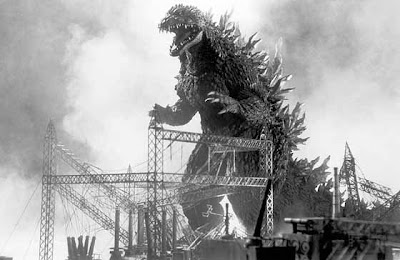
So anyhow, we realized we had a little tyrannosaur on our hands. Infants don't joke around, when it comes to something they need, but in a near-toddler (at that point--she wasn't even crawling yet), it was pretty surprising to see basic instinct rear itself up to near-violence. It became a bit of a joke between us, and I started referring to Eva occasionally as godzilla.

(I've been searching for a good nickname for our daughter, since my father came up with one of the very best I've ever heard of, for my elder sister Julie: J-bird. Even better than Bops' calling my mother "pud"--that's pronounced "pood", as in short for pudding, not as in "pudley" or anything insulting like that. Anyway...)

Plainly godzilla would be a cruel and derisive nickname to give a girl. I might've deserved it as a small boy, but my mother's sense of humor was quite a bit gentler than mine is. In Eva's infancy, I called her "Rocky" because she slept with both her arms raised above her head, as if in triumph. But she stopped doing that so I figured it was time to let that one go. Sometimes I've called her Thumper, because of how she learned to crawl (from me) by slamming the floor with her hands, something she still does. That's a little better because there's a bunny rabbit in children's literature named Thumper, but still, it seems a little mean-spirited. It's not good to be too sarcastic with a child, I think, particularly in how you address her. Who knows, maybe things will turn out like in Dirty Dancing, and I'll just call her "Baby" until she's about 40. I have no idea.

So godzilla was mostly a memory, until Thursday night. Kate having mostly recovered from her mysterious maybe-Lyme disease, she ventured to have a small frozen pizza, while I made some pasta for myself. Things were a bit discombobulated, with Kate taking a late-afternoon nap and Eva threatening to blow up because she was hungry, so I gave the little girl her own dreadfully dull dinner while I began preparing my own meal (garlic and shrimp in tomato sauce--the key is to drain off the water from the shrimp so the sauce stays thick).

True to form, Eva ate quite a bit while I worked, and got things bubbling on the stove. She was done by the time Kate came to, entered the kitchen and got her pizza going. We thought we'd have a more relaxed dinner than usual, since Eva had already eaten and wouldn't need constant tending.

We sat down and she walked over to Kate, put her hands on Kate's leg and began crying. Only she refused mouthfuls of food when offered, turned her head away and began crying even more insistently. We put her back in her high chair and tried giving her a second dinner, with no more success, only a steadily worsening tantrum.

There are times I come close to losing my temper in return, when I see my child in discomfort and she resists my best efforts to help. I know getting angry in return won't accomplish a thing, but it's impossible to avoid the reaction. The little imp doesn't know what's good for her sometimes...

Kate and I were both worrying that this wasn't an ordinary tantrum. Kate herself might have been suffering from Lyme disease, and though it's not contagious, still, any vectors Kate was exposed to, Eva probably was too. What if the little baby was in constant; head-to-foot pain, and every motion was agony? What if she were in serious abdominal distress, and had no words to tell us with?

Kate took her temperature--twice--and confirmed there was no fever. What, then? Kate brought her back into the kitchen, and nearing her wits' end, placed the baby on her lap and gave her a whole piece of pizza to munch on.

Quiet. Blissful, immediate, profound quiet, as the thirteen-month-old girl wrapped both hands around the wedge of pizza, sunk her teeth into it, and began suckling. And that's virtually what she did--take occasional bites, and chew them, but otherwise simply kept her mouth clamped on the pizza, held it firmly in both hands, and looked me straight in the eye with satisfaction and almost a hint of defiance.

For twenty minutes nothing changed, except that 3/4 of the piece of pizza disappeared, and Eva's drool was now dripping off the bottom of the crust onto her pants leg.

If Godzilla were to run into a mountain range made of baked ham, and settle down to eat it for a day or two, the effect would have been similar. The Sutherland house went from baby-induced pandemonium to bucolic in less than a moment.

Next night, more pizza, of course. Because it was Friday, and Friday means homemade pizza in our house (as Sunday means clean-out-the-leftovers). Only this time we were wise to it, and devoted one whole piece (garlic included) to the baby, though we did cut it into smaller pieces (the crust being much fluffier than the frozen one the night before). We ate in front of the TV, watching Celtics preseason basketball (still too difficult to talk about last season), with their six top players on the bench and the subs nearly taking Philly down. (Philly's terrible, and even they know it.) And Eva was happy as she'd been earlier, laughing, smiling, babbling "da-da" and clucking her tongue like she does when she's happy.

And that's good. Because when she's not...


Sunday, October 10, 2010

Samwich Fayah

I'm not above a little joking Down-Eastese, since I'm a native New Englandah and the only person I've ever known personally who genuinely spoke in such an accent, and honestly ended every sentence with an "ayuh", was from Cambridge, Massachusetts. It's part of my heritage, you never know where you'll find it, and humor generally involves a bit of affection anyhow. Things we truly despise we don't laugh at.

And besides, county fairs themselves are about as rural American as you can get, along with huntin', fishin', fahmin' and maple syrupin'. And that's not just to be cliche'd about it. Fairs grew up as exhibitions especially for the farmers. These days the midway rides, shyster games and cotton candy have taken over, but generally half a fair is old school, livestock exhibitions, prize vegetables, horse, ox and tractor pulls, 4-H and a bluegrass band or two.

I'm not saying anything new to anyone from New England, or from further abroad where nature plays much of a role in daily life. Last summer, working in Alaska, I was treated to the weeklong extravaganza known as the Alaska State Fair, just like the Sandwich Fair only about 10 or 20 times as big, and including a demolition derby. Plus, I'll always have a fond spot in my heart for the 4-H exhibit by the teenage girl about slaughtering pigs, which included photos of her picking up a blood-covered knee from one of the dead animals and making like it was a football, or a microphone:

Now that's personality. I admire that.

Kate's no stranger to the harvest-season fair either, having grown up in the general vicinity of the Fryeburg Fair, which ranks between Sandwich and Alaska, but closer to Sandwich, for size. (And for the record, I've never been to one of the really giant fairs in the midwest, like in Kansas or Nebraska or Oklahoma or Texas. All I can say about those is based on an essay by the late (and great) nature essayist, Noel Perrin. He wrote an essay on, I think, the Kansas State Fair, entitled "773 Prizes for Sheep". Enough said.) So I'm dealing with the pipsqueak fairs anyway, even including Alaska (which isn't exactly one of the breadbasket states). But still. In some sense, a fair's a fair and I've been to plenty.

Kate didn't go to any last year, recovering as she was from birth, and Eva still being too small and delicate to spend long periods of time out of doors. (Infants are a lot tougher than their parents generally give them credit for, but then again, why go testing their limits merely for the fun of it? If Kate honestly had no choice but to be outdoors all day with a newborn Eva strapped to her back--say, actually harvesting back in the colonial days--I'm willing to bet Eva would've turned out just fine. Even healthier maybe, for exposure to the air. But neither of us feel like playing with our child's well-being quite so aggressively. Anyway...)

So there's this fair. It takes place in Sandwich, NH, about ten miles north of the house I grew up in. Sandwich is a small--quiet is kind of loud compared to what that town is like--town just south of the White Mountains, and it's been deliberately kept almost comatose by the landowners there, who steadfastly oppose any road connecting their town to the ski mecca just to the north. Sandwich is dominated by wealthy landowners, many industrialists from Boston and elsewhere, and this little town is their retreat. There is a lot of wealth and intelligence sequestered among the pines there, so much that it's sometimes jokingly referred to as the "Athens of the north".

Growing up, I visited Sandwich once a year: for the fair. When I was a twerp, it was billed as "New England's Biggest One-Day Fair!", and we'd be up by 5:30, putting on thermal underwear, long socks and heavy boots, driving up bumpy old Sheridan Road in a freezing cold station wagon, parking along the roadside and walking the last mile or so to the front gate of the fair.

I mean, we earned it.

Now it's a three-day blowout, there's four times as much parking in the surrounding fields, and since winter has virtually disappeared shorts, sneakers and sweatshirts are the most common clothes for kids. Saturday, however, it was actually somewhat cold, in the 60s and breezy, so when a cloud came between us and the sun, it was downright chilly. Even so, there hadn't been a trace of frost, and it was so dry that the normally ubiquitous mud was nowhere to be seen.

Despite all that, the Fair was the Fair, and I hadn't been in close to a decade. For my part, after a big honking portion of fried dough and a cup of coffee, I'd satisfied about half of my craving for the fair, the other half being looking for any chintzy souvenir I might want to take home. But that wasn't necessary, since I already have enough clothes to last me for the next decade or two (unless I get fat), and I have about enough honky tonk wear for my tastes. Like my holstein cowboy hat, my fake-snakeskin-but-really-cowhide cowboy hat, and my favorite, my Kill Bill jacket. (Kate especially hates that one, guaranteeing I'll keep it.)


One honky-tonk... Two honky-tonk...
...three honky-tonk!

So I didn't need any more schlock. (Couldn't afford it even if I did.) After the fried dough and a tour through the arts & crafts, the rest of our time was more spent with the family: Lisa had driven out from Pennsylvania, and Julie & Hals had come up with the boys, spending a day at the Fair before taking a four-day hike in the White Mountains. (Julie's no girlie girl, but I respect how she's willing to do down-and-dirty stuff to keep the men in her life happy. She was upset at the thought of not showering for half a week, but I reminded her that everybody else would smell as badly as she did, so it didn't matter.)

Kate and I had just barely made it up, since Kate spent the entire week home, most of it in bed, with some strange, as-yet undiagnosed ailment that basically paralyzed her for two days. Possibly it was Lyme disease, though the blood test came back negative (though false negatives are common enough with that disease). So far the antibiotics have restored her mobility, but they have other side effects which have laid her low again today.

Kate's two good days were the days central to our plan: the drive up Friday, and the Fair on Saturday. I lightly cracked the whip--I don't give myself much practice at that kind of thing, so I'm really not much of a taskmaster--to get us out of the house by 9:30 Friday morning, to beat the Boston traffic. It's horrific on Columbus Day weekend, leading to 5-hour commutes from Boston to Moultonboro, and 6+ hour commutes from Boston to Portland. We successfully beat it, had time for a leisurely lunch in Concord, and then rambled on up to Wonalancet, a tiny little village north of Sandwich, where we were staying with an old friend of mine, my 5th-6th grade teacher, Chele Miller.
Chele was the first person I told that Kate and I were going to get engaged--in an as-yet unwritten chapter of the Pup & Ben series--in the upstairs lounge at the Corner House (my second-favorite New Hampshire restaurant behind the Common Man). She'd offered to put us up should we return, so we took her up on the offer and all had Chinese that night for dinner before knocking off to sleep.

Our Saturday wasn't too early, considering Kate likes her mornings in (so do I, but she really treasures hers), and it takes about an hour to get Eva ready for anything (food, diaper, change, play a little bit to settle her down). So it was moving toward noon by the time we finally entered the fair.

Eva, just over a year old, of course had no clue as to where she was or what was going on. But when she's stimulated, she shows it, and she loved the midway games. Not long after we arrived, Eva met a miniature horse, and a little bit later Kate bagged a small stuffed crab for her at a basketball game (and we both had to keep her hands off the merchandise in the arts & crafts stalls).


But maybe the high point of the day for her was the merry-go-round, which she actually enjoyed quite a bit. Kate suggested it, and I thought Eva might dislike it as too noisy and fast, but not at all (though she didn't love the saddle at first).

That night at dinner, at the Corner House again (right across the street from the fairgrounds), all of us Sutherlands and Platts sat down with Chele and spent a few hours chowing down and telling stories. Eva amazed us all by drinking a good honest 8 oz of apple cider (more than she'd ever had from a cup), and then more milk besides. (Kate's mother is right: wean the kid, and thirst will teach them how to drink from a cup!)


When things like how much the baby drank are among the headlines of the day, you know it was a very placid day. And that it was: enjoyable and placid.

After Wednesday night's emergency room adventure, placid was just fine. (And maybe the emergency room will merit its own post, but not right now. Suffice it to say, even ordering and eating pizza there is a trial.)